
Advice to Flint Residents
Important Resources
To get your water tested for free
Email flintwater@cityofflint.com or call the Flint Water Plant: 810-787-6537
For free filters and home water testing kits
Please see our fact sheets or call EPA's local Flint hotline: 810-434-5122
Questions about safe water
Email flintwater@epa.gov
Call EPA's hotline: 810-434-5122
Health questions (including skin rashes or blood tests)
Rashes: You can contact your primary
care provider, or call 2-1-1
Blood tests: You can contact your primary
care provider, or call 810-257-3833
Appearance or odor of your water
Call Flint Water Plant: 810-787-6537
Cleaning Faucet Aerators
Many taps have an aerator as part of the faucet assembly. Aerator screens are not intended to remove contaminants in the water, but may trap sediment or debris as water passes through the faucet. Lead-bearing sediment may end up in drinking water from physical corrosion of leaded solder and can build up in the aerator over time. EPA recommends Flint residents clean faucet aerators weekly.
Fact Sheet: Keeping Your Home Lead Safe - Clean Your Aerators Exit
How to Use a Faucet-Mounted Water Filter
These are simplified instructions. For complete directions, refer to the owner's manual.
- Both unfiltered and filtered water can run with the filter attached.
- For filtered water, switch the lever so water will flow under the new cartridge.
- The filter also has a screen that should be cleaned weekly.
Video: Water Filter Installation and Maintenance (Spanish)
Video: Water Filter Installation and Maintenance (American Sign Language)
Identifying Lead Service Lines
If the plumbing in your home is accessible, you may be able to inspect your own plumbing. Otherwise, call your water provider or hire a plumber.
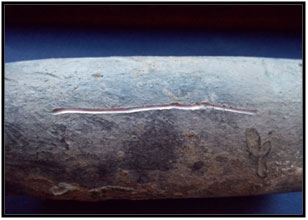 Lead service lines are generally a dull gray color and are very soft. You can identify them easily by carefully scratching with a key. If the pipe is made of lead, the area you've scratched will turn a bright silver color. Do not use a knife or other sharp instrument and take care not to puncture a hole in the pipe.
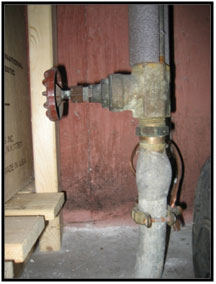 Lead service lines can be connected to the residential plumbing using solder and have a characteristic solder "bulb" at the end, a compression fitting, or other connector made of galvanized iron or brass/bronze.
 Lead service lines often end just inside the front or side wall of the home, but may extend further into the building as shown, where the lead service line comes out of the basement floor to the water meter and then back into the floor, continuing further into the building.
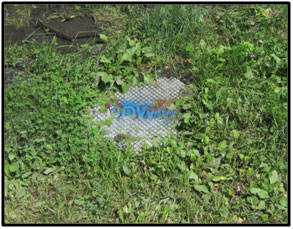 If your home has a water meter, your water meter may be in your home or in a "meter pit" or "meter vault" as shown above.
Some common situations (click to enlarge images):
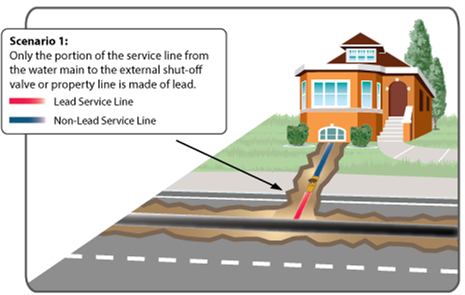 Scenario 1: Only the portion of the service line from the water main to the external shut-off valve or property line is made of lead, and the portion from the external shut-off valve or property line to the home is made of a different material, such as copper or galvanized iron pipe.
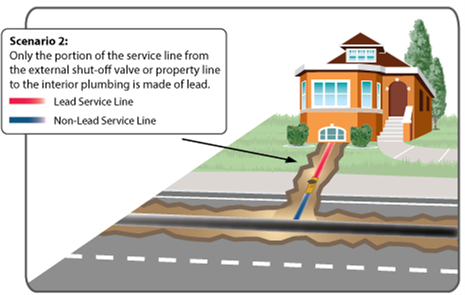 Scenario 2: The city may have replaced the portion of the lead service line from the water main to the property line or external shut-off valve to the property with another pipe material, and only the portion of the service line from the property line or external shut-off valve to the home is now lead.
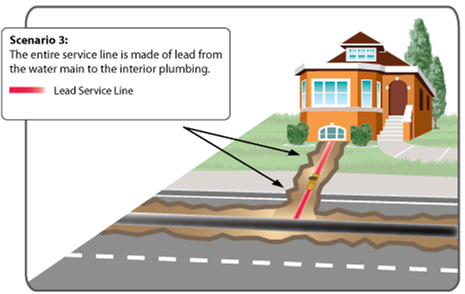 Scenario 3: The entire service line from the water main to the home may be made of lead.
Your house might also have a short segment of lead pipe — commonly called a "lead gooseneck" — that connects the water main to the service line. You cannot inspect the gooseneck since it is under the street.